Showing posts with label Planck satellite. Show all posts

Wednesday, November 3, 2010

Never-before-seen galaxy clusters make shadowy debut.

You can run, but you can't hide from the Atacama Cosmology Telescope... especially if you're a massive galaxy cluster. Located high in the mountains of Chile, this telescope takes measurements of the CMB, the radiation that has filled the entire universe since the time of the big bang. Earlier this year, the Plank telescope mapped the CMB with unprecedented accuracy. Now, the ACT is providing astronomers with a way of using this radiation to discover galaxy clusters long before observing them visually.


The Atacama Cosmology Telescope, located in the Andes Mountains or northern Chile.
Image courtesy of Till Niermann.

About 300,000 years after the big bang, the universe had cooled and expanded to such an extent that photons could finally travel freely across long stretches of space without being absorbed by atoms. The background radiation that astronomers observe today is made up of those same primordial photons, whose wavelengths have been stretched by the expanding universe. The CMB now reveals itself as a faint 2.7K glow in the microwave range of the electromagnetic spectrum. Small anisotropies in the CMB sky denote regions of the universe that are either slightly more dense or slightly less dense than average.


WMAP provided one of the first maps of the CMB sky.
Image courtesy of NASA.

Thanks to the Atacama Cosmology Telescope, a team of astronomers from Rutgers University was able to predict the locations of several massive galaxy clusters from these anisotropies in the CMB. "The hot gases within the galaxy clusters cause a tiny fraction of the cosmic background radiation to shift to higher energies, which then makes them appear as shadows in one of ACT's observing bands," explained Jack Hughes, a senior member of the team. This phenomenon, called the Sunyaev-Zel'dovich (S-Z) effect, was predicted back in the 1970s, and has been experimentally verified a number of times since its conception. Astronomers hope that the unparalleled sensitivity of the ACT will provide them with more extensive results than ever before. In the game of galaxy detection, new technologies like the ACT are changing all the rules.

Monday, July 5, 2010

The universe, as seen through new eyes.

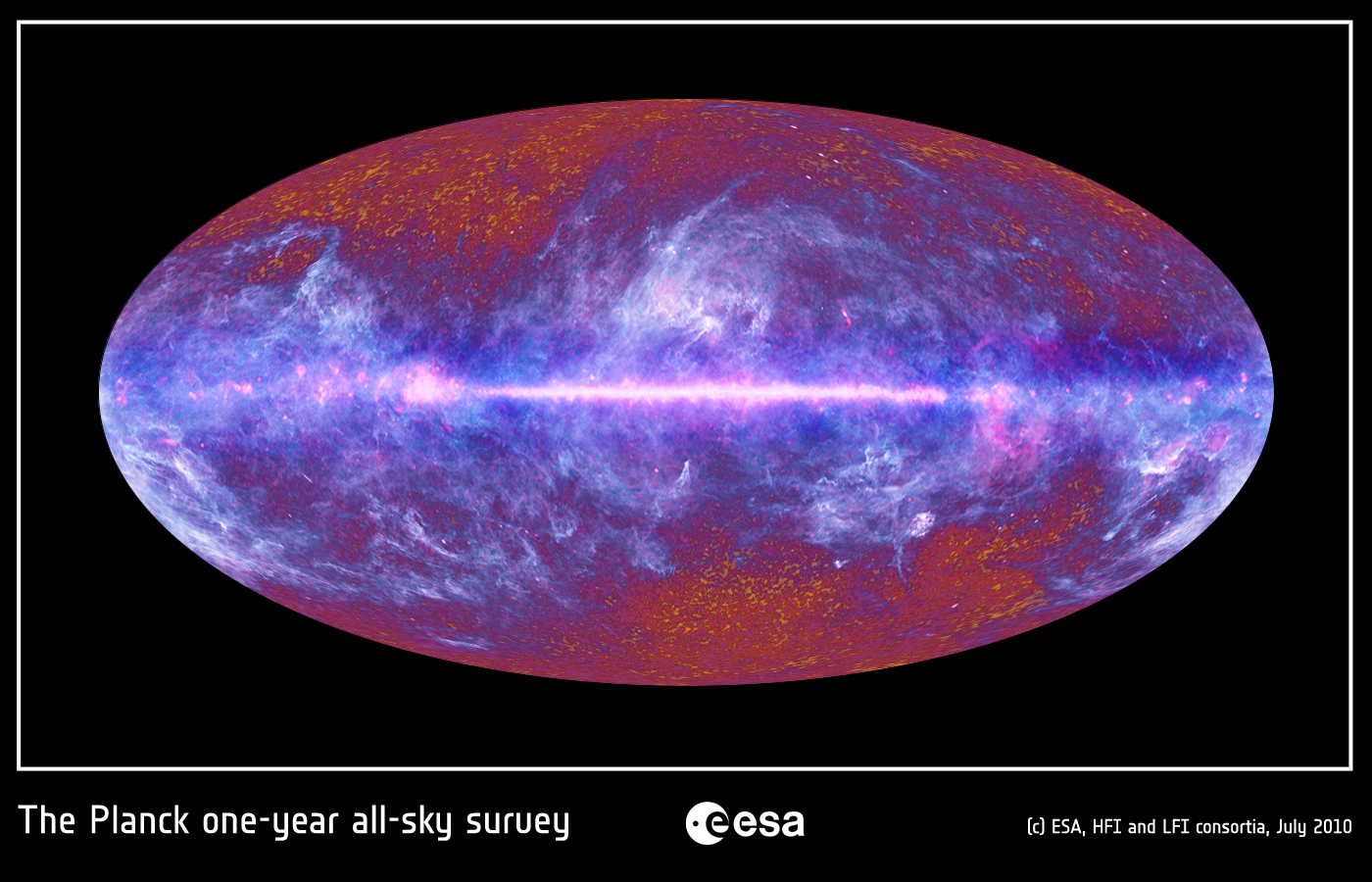
The European Space Agency has just released the most sophisticated picture of our universe taken to date. Assembled using strips of data from the Planck satellite, launched in May 2009, this image depicts both the large-scale structure of our own Milky Way galaxy and the Cosmic Background Radiation (CMB) that fills the entire universe. Here, have a look:


Image courtesy of ESA.


The center line that runs through the image is the galactic plane, sprawling across our field of view the same way it does in the sky on a clear night. The wispy, silvery-blue projections extending out of the galactic plane detail the large-scale structure of the Milky Way. But it is the top and bottom of the image, above and below these majestic plumes of gas, that show the real prize: the cosmic microwave background.

Immediately after the big bang, our fledgling universe was nothing but a hot, dense soup of charged particles. At an age of about 300,000 years, the universe had cooled enough for atoms to form, allowing light to travel freely for the very first time. Today, astronomers detect this primordial light as a nearly homogeneous 2.7K radiation that fills the entire sky. (2.7K is incredibly cold, by the way. At less than three degrees above absolute zero, detecting it in the first place is one of the modern miracles of science.) Small temperature fluctuations in the CMB are visible in this image as tiny yellow and green spots. Slightly overdense regions are hotter than the surrounding 2.7K radiation, while slightly underdense regions are cooler. It is these anisotropies that gave rise to all the structure we see in the universe today. Stars, galaxies, galaxy clusters... all of these objects were born of slightly overdense areas of radiation in the very early universe.

You may have seen similar images before. Two previous missions, COBE in 1996 and WMAP in 2003, have already measured the CMB; however, Planck will map this radiation with unprecedented accuracy. Astronomers are hoping that the current mission will allow them to glimpse evidence of inflation, the accelerated expansion the universe is believed to have undergone very early in its development. The stunning image above is only the first of many to come, and is probably the most crude. Researchers will have to eliminate the "noise" caused by the Milky Way if they are to properly map the CMB across the entire sky. Luckily, Planck's refined observations between now and 2012 should allow them to do just that.

For more on the CMB, check out this paper written by an incredibly beautiful, witty and smart young cosmologist.